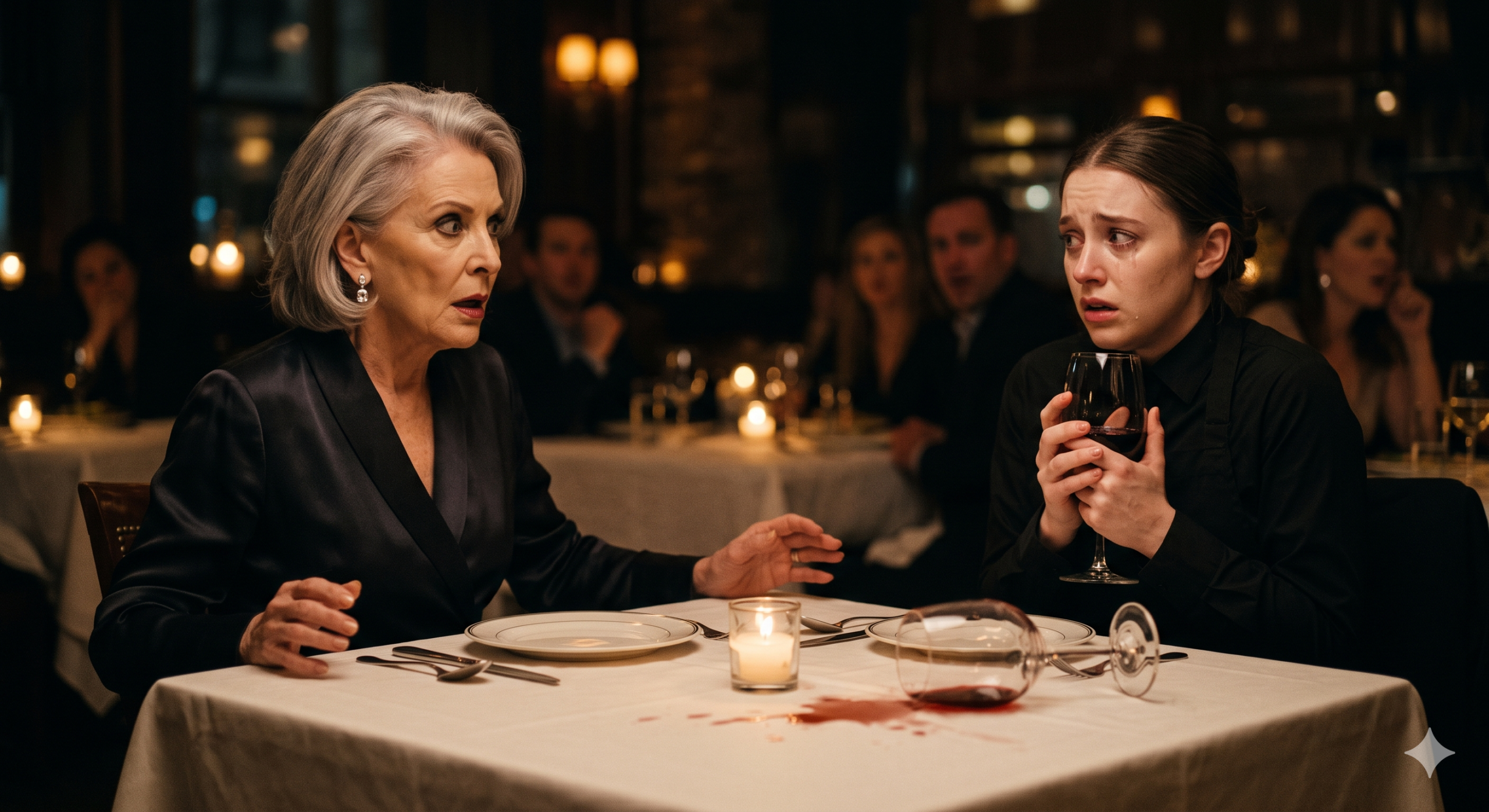
The Onyx Room didn’t tolerate noise. It was the kind of place where a dropped fork made the whole dining room look up.
Eleanor Sterling had chosen it for exactly that reason.
She sat across from Julian with the composed authority of a woman who had never once been second-guessed—not by a senator, not by a courtroom, and certainly not by her own son. Her silver hair was architectural. Her gray eyes were surgical.
Julian adjusted his cuffs for the fourth time.
“Your quarterly numbers are an embarrassment,” Eleanor said, cutting a sliver of foie gras with total precision. “The Chicago hub was supposed to prove you could operate independently. Instead, you’ve bled two million in six months.”
“The FDA audit timing was—”
“Was your problem to anticipate.” She set down her knife. “Your father used to make the same face you’re making right now. That soft, pleading look. Do you know where it got him?”
Julian said nothing. His jaw tightened.
“Bankruptcy and a cardiac event at fifty-three,” Eleanor said. “I did not spend thirty years building this company so you could inherit it and coast.”
A phone buzzed against the tablecloth. Eleanor glanced at the screen—her jaw shifted slightly, the way it did before a major acquisition.
“The Chairman. About the Voss merger.” She picked up the call without looking at Julian again. “Sit quietly.”
She turned toward the window. Fifth Avenue glittered below. Her voice dropped into that low, commanding frequency she used for boardrooms and courtrooms—entirely absorbed, entirely elsewhere.
Julian was left alone.
Maya had been working The Onyx Room for exactly fifty-three days.
She was twenty-two, NYU junior, and currently $31,000 in debt. The tips here were obscene—twice what she’d made at the sports bar in Chelsea. She’d learned quickly that the job was eighty percent invisibility and twenty percent anticipation. You noticed everything. You said nothing. You appeared only when needed.
She was stationed in the shadow of the velvet partition, silver tray in hand, watching the Sterling table the way you watched a storm from a window.
The woman was something—the kind of presence that made the room feel smaller. But Maya had been watching the son, too. The way he kept checking the entrance. The way his knee bounced under the tablecloth.
When the woman turned to the window, Julian changed.
Not slowly. All at once.
His hand went inside his jacket with the clumsy urgency of someone who’d been rehearsing the motion for days and still couldn’t make it smooth. He pulled out a small vial—no bigger than his pinky, glass, clear liquid inside.
Maya’s tray shifted in her grip. She caught it.
Medicine, she told herself. Maybe she has a condition. Maybe it’s vitamins.
But she’d seen people’s faces when they were helping someone they loved. Julian’s face was not that.
His lips were pressed together so hard they’d gone white. His eyes were wet and frantic and somewhere else—far past this table, past this restaurant, past any version of his life that still felt salvageable. He popped the vial open with his thumb. He leaned across the table. He poured it into the wine.
The dark red Cabernet absorbed the clear liquid instantly. No color change. No cloud. Nothing.
Julian sat back. Exhaled. Wiped his forehead with a folded handkerchief.
Maya stood absolutely still. Her heart was doing something wrong in her chest—too fast, and then skipping entirely.
She thought about her manager. About the Sterling legal team. About being twenty-two and broke and what it would mean to accuse a man like this and be wrong.
Then Eleanor Sterling turned back from the window.
“The acquisition is resolved,” she said, satisfied. “Voss’s stock will crater by Tuesday.” She set down the phone. “Now. Where were we.”
She looked at the glass.
She reached for the glass.
Maya dropped the tray.
The sound was enormous.
The crystal carafe hit the marble and detonated. Water and glass fragments fanned across the floor. Every head in the restaurant turned.
Maya was already moving.
She crossed the distance in three strides and hit the wineglass with the flat of her hand—a hard, precise blow that sent it spinning off the table. It struck the edge and shattered. The Cabernet landed across the tablecloth and Eleanor’s silk jacket in a wide, dark bloom.
Silence.
Complete and total silence.
Eleanor looked at her ruined jacket. Then at the red-soaked linen. Then slowly, with the controlled deliberateness of someone who had won more battles than most people had ever entered, she looked at Maya.
“Explain yourself.” Her voice was quiet in the way that a scalpel is quiet.
Julian was on his feet. “Security! Get security up here—she just attacked—”
“She attacked no one.” Eleanor’s voice cut him off without raising. Her eyes hadn’t left Maya. “You. Explain.”
Maya’s hand was bleeding. She hadn’t noticed when it happened. A thin line of red tracked down her palm from a glass shard, and she pressed the edge of her apron against it and stood straight.
“While you were on your call,” Maya said, “your son took a vial from his inside jacket pocket and poured it into your wine.”
The dining room might as well have been an empty building.
“That is a lie,” Julian said. His voice had gone high and thin. “Mother, I don’t know who put her up to this—it’s extortion, it’s—”
“Show me your pockets, Julian.”
“I’m not going to—”
“Show me your pockets!” The roar came from somewhere below Eleanor’s composure, from a place Maya hadn’t seen her access yet. It was not rage. It was terror in the register of authority. The maître d’ flinched backward. A woman at a neighboring table set down her fork.
Julian’s face crumpled.
For one long moment, he stood there in his Tom Ford suit with his vintage Rolex and his Ivy League jaw, and then it all fell off of him at once—the performance of it, the scaffolding of someone who had spent his entire life trying to exist inside his mother’s definition of acceptable.
“You were going to cut off my trust,” he said. His voice cracked. “The end of the year. You said it yourself—you were done with me. And I owe people money, Mom. Not the kind of people you negotiate with. They said if I didn’t have it by Friday—”
“Stop.”
“—they said they’d come to the house. I didn’t—I didn’t know what else to—”
“Stop talking.” Eleanor’s voice was barely audible. “How much?”
Julian wiped his eyes with his sleeve. “Three million. Macau. Some of them are—they’re not legal businesses, they’re—”
“And you decided,” Eleanor said, each word like a step on ice she wasn’t sure would hold, “that the answer was to poison me.”
“I found something on the darknet. It mimics a cardiac event. There would have been no trace in any tox screen—”
The security guard stepped forward and pinned Julian’s arms behind him. The other guard reached into Julian’s jacket and pulled out the empty vial.
Julian stopped talking. He just wept—ugly, unguarded, the kind of crying that happens when there’s no self left to protect.
Eleanor watched him. She sat completely still in her wine-soaked jacket and watched her son be restrained in a Manhattan restaurant she had chosen for its silence.
The maître d’ was saying something about the police, about the security footage, about calling the NYPD. Eleanor nodded without looking at him. She said “yes” and “the vial” and “have them pull the camera from this section” in the distant, functional voice of a woman handling a logistics problem.
And then she sat very still and said nothing at all.
Maya hadn’t moved. She wasn’t sure she was supposed to.
Her hand had stopped bleeding. Someone had brought her a clean cloth, she didn’t remember who. She stood beside the wreckage of the table—the broken glass, the stained cloth, the spilled wine soaking into linen that probably cost more than her rent—and waited.
Sirens started up somewhere below on Fifth Avenue.
Eleanor turned from the window.
She looked at Maya for a long moment. The executive composure was still there, the stillness, the precise posture—but something underneath it had shifted. The way a building looks structurally intact after an earthquake while the ground it stands on has moved.
“You could have said nothing,” Eleanor said.
“Yes.”
“You were afraid.”
“Yes.”
“And you did it anyway.”
Maya didn’t answer. It wasn’t a question.
Eleanor reached out and touched her shoulder—one brief, deliberate gesture. Then she pulled her hand back and folded it in her lap.
“Your name.”
“Maya.”
“Maya.” She nodded, as though confirming something. “You’ll be compensated. Generously. Whatever you’re owed and more.” A pause. “What are you studying?”
“Pre-law.”
Something moved behind Eleanor’s eyes. “Good,” she said quietly. “The world needs more people who act before they calculate the cost.”
The NYPD officers were at the entrance now, being directed toward the VIP section by a pale and trembling maître d’. Julian was still in the security guard’s grip, his Rolex catching the restaurant light. He looked at Maya once—not with anger, not even with betrayal. Just with the hollowed-out exhaustion of someone whose worst version of themselves had finally been witnessed.
Eleanor did not look at her son again.
She looked out at Manhattan. The yellow cabs below. The dark mass of Central Park visible at the edge of the skyline. The city that had made her and that she had spent forty years making—the deals, the hostile acquisitions, the rivals she’d outmaneuvered and the regulations she’d shaped, the empire she’d built on the premise that sentiment was a liability.
The police reached the table. She stood to meet them—straight-backed, composed, answering their questions in complete sentences.
And Maya watched Eleanor Sterling do what she had always done: hold herself together by sheer force. Face forward. Stay functional.
Only this time, the thing she was surviving was not a competitor or a market crash or a hostile board.
It was the knowledge that the only person in her life who should have been permanent had looked across a dinner table and decided she was worth more dead.
The lead officer took Eleanor’s statement. The vial went into an evidence bag. Julian was walked out of The Onyx Room in handcuffs, through the dining room where every remaining patron had stopped pretending not to watch, past the bar where the bartender stood motionless with a glass in his hand, out through the entrance and into the cold Manhattan night.
Eleanor watched him go.
Then she turned back to Maya.
“Your scholarship,” she said. “NYU, I assume?”
Maya blinked. “Partial. I’m carrying loans.”
“You won’t be.” Eleanor said it the way she said everything—not as an offer, but as a fact about the future that she had already decided. “My office will contact you by end of week. The rest of your tuition. Bar exam fees. First year of practice costs, if you need it.” She paused. “Consider it a retainer. I have a feeling I’m going to need a good lawyer in the next several months.”
Maya looked at her. “I’m not a lawyer yet.”
“No,” Eleanor said. “But you already think like one. You observed. You assessed the risk. You acted on principle rather than self-interest.” She picked up her phone from the wine-stained table. “That is more than I can say for most of the people I pay six figures a year.”
She walked toward the exit. At the entrance, she paused without turning around.
“The wine was a 2013 Screaming Eagle,” she said. “Nine hundred dollars a glass. A waste.” A beat. “Although I suppose if it was going to be wasted, that was the correct way.”
She walked out.
The Onyx Room exhaled.
Maya stood in the wreckage of the most expensive evening she would ever work and looked at the empty chair where Eleanor Sterling had sat, and the stained tablecloth, and the outline of the shattered glass.
Three weeks later, she received a letter from Sterling Pharmaceuticals’ legal department. Inside was a tuition payment confirmation to NYU’s bursar office—full balance, all remaining semesters—and a brief handwritten note on heavy cream stationery:
You dropped the tray on purpose. I know. A person in genuine panic does not move with that kind of accuracy.
Neither do bad lawyers.
— E.S.
Maya read it twice. Then she folded it and put it in her desk drawer, next to her lease agreement and her LSAT prep books and the small bandage she still wore on her palm.
She had three years of law school left.
She intended to use them.
Julian Sterling was arraigned on attempted murder charges the following Tuesday morning. His attorney—not one of the Sterling firm’s retained counsel, who all declined—entered a plea of not guilty.
The security footage from The Onyx Room’s VIP section showed everything.
The trial date was set for March.
Eleanor did not visit him in holding. She did not send a letter. She instructed her estate attorney to begin the process of removing Julian from the trust entirely and updated her will within the week.
She made no public statement.
She returned to work on Monday, eight hours after giving her statement to the NYPD, and spent the day in back-to-back meetings about the Voss acquisition, which closed on schedule.
She did not mention the dinner. She did not mention her son.
On Tuesday, Voss Biotech’s stock dropped 34 points, exactly as she had predicted.
Eleanor noted it, made two calls, and moved on.
It was what she had always done. It was the only thing she knew how to do.
And for the first time in forty years, she wasn’t entirely sure whether that was strength or the most elaborate kind of damage she had ever seen up close.
Original fictional stories. AI-assisted creative content






Leave a Reply