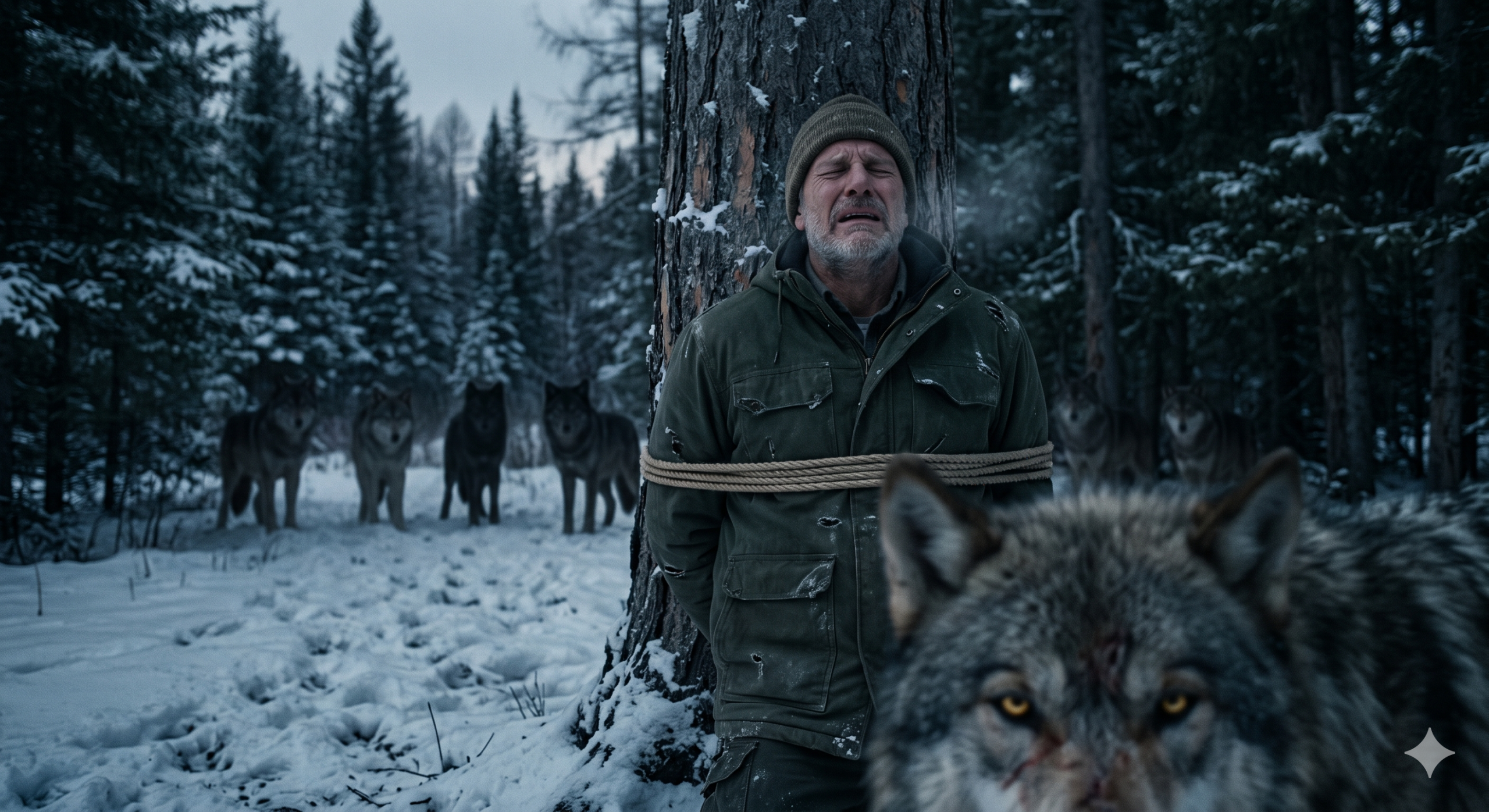
The rope cut so deep into John’s chest that every breath was a negotiation.
He’d been lashed to the larch for close to three hours now. Forty below wind chill. No radio. No rifle. No lighter. Just the stupid, stubborn fact that his heart was still beating.
“No hard feelings, ranger.”
Hank’s voice kept replaying in his skull — that lazy, almost bored drawl, like he was canceling a dentist appointment, not leaving a federal officer to die.
“Three grizzly pelts puts us in federal-sentence territory. Easier this way. Blizzard got you. Tragic. The state boys won’t even push the canyons till April.”
Then they’d walked away laughing.
John had watched their snowmobile tracks fill with fresh snow until there was nothing left of them. Until it was just him and the cold and the pines.
He forced his lips to move, whispering names.
“Sarah. Katie. Sarah. Katie.”
His wife. His daughter. The fireplace in Billings. He built pictures of warmth the way a drowning man builds rafts — frantic, desperate, anything to stay above the surface.
His toes had stopped hurting twenty minutes ago.
That was the thing that scared him most. Not the pain. The absence of it.
He knew what that meant.
The forest changed.
It didn’t make a sound. It just changed — the way a room changes when someone walks in behind you. A shift in the quality of the silence. A new weight to the dark between the trees.
John turned his head, slow and painful. His neck had gone stiff as lumber.
Shadows. Three of them. Then two more. Then seven total, materializing from the timber like smoke taking shape.
Wolves.
His stomach dropped to somewhere below his frozen feet.
He’d worked this wilderness for twenty-two years. He knew wolves. He knew what a pack moving in silence meant — it meant they weren’t worried. It meant whatever they were circling had already lost.
They didn’t rush. They never do. They just tightened the ring, those yellow eyes catching the last gray light of the afternoon, unhurried and ancient and certain.
Seven of them. All lean from the winter. All hungry.
John closed his eyes.
Not like this. Not like this. Not—
He opened them.
If he was going to die here, he was going to watch it.
The alpha stepped out from the group. Massive — two hundred pounds at least, maybe more. A scar split his face from brow to muzzle. His left ear was torn, healed ragged. He moved the way only old fighters move — no wasted motion, nothing to prove.
He stopped four feet away.
His head dropped low. He was scenting. Sorting through the layers — frozen sweat, cortisol, blood from where the ropes had split the skin at John’s wrists.
One more step.
John could see individual hairs on the wolf’s chest. Could feel the body heat rolling off him. Could smell the raw-meat, iron-cold smell of his breath.
He braced.
The wolf made a sound.
Not a growl. Not a snarl. A sound John had never heard from a pack alpha circling prey.
A whine. Low, questioning, from the back of the throat.
The wolf lifted his head and stared directly into John’s face. And the hunger in those yellow eyes — John watched it happen in real time — the hunger dimmed. Something older moved in underneath it.
The wolf pushed his muzzle into John’s jacket and inhaled.
Long. Deliberate.
Then he raised his head and touched his cold wet nose to John’s chin.
John stopped breathing entirely.
His gaze dropped to the wolf’s front right paw. He had to blink twice against the cold-blur in his eyes.
A scar. Smooth, semi-circular. The specific shape that only one thing in this world makes.
A steel jaw trap.
The memory hit him so hard it was almost physical.
Five years back. Early spring thaw in the Yellowstone corridor. Snowmobile rounds, midmorning, when he heard it.
A whimper. High-pitched. Coming from the canyon drainage.
He almost rode past it. He didn’t.
The pup was maybe ten weeks old, caught in an illegal steel-jaw trap some poacher had abandoned. Left foreleg mangled in the grip. Exhausted to the point of stillness — just trembling, a small gray bundle with enormous terrified eyes.
No mother anywhere. Likely shot.
The pup tried to bite him. Barely had the strength for it. Tiny milk teeth snapping at the air.
“Easy, boy,” John had murmured, pulling off his uniform jacket. “I’m not your enemy. Easy.”
He threw the jacket over the pup’s head. Put his full weight into prying the trap springs apart. It took three tries. His hands bled.
The bone was intact. Barely.
He brought the pup back to the outpost. Didn’t file paperwork on it — he knew what happened to injured wolves in the system. For three weeks he hand-fed him, cleaned the wound twice daily, slept on the floor next to the crate because the pup whimpered in the dark.
He called him Smokey. For the smoky gray of his coat.
The pup followed him everywhere. Underfoot constantly. A trip hazard with a wagging tail.
But John knew the rule. Wild things belong to the wild.
When Smokey was strong — really strong, paw healed, weight back, that spark of feral independence finally lighting in his eyes — John hiked him deep into the protected corridor.
He crouched down. Scratched the wolf behind his torn ear one last time.
“Go on, pal,” he said. “This is yours. Stay away from humans.”
Smokey had stared at him for a long moment. Then he turned and walked into the tree line.
He looked back once.
Then he was gone.
“Smokey,” John breathed. His voice was barely there — cracked lips, frozen throat, barely a whisper. “Is that you, boy?”
The wolf’s ears came forward.
He whined again, and this time it cracked something open in John’s chest — something he’d been holding shut with pure grim stubbornness for three hours.
Behind Smokey, the pack grew restless. One of the younger males took a step forward, shoulder dropping, reading the hesitation as weakness, as opportunity.
Smokey spun on him.
The snarl that came out of him filled the entire forest. It was not a warning. It was a verdict. The younger wolf’s ears flattened so fast they nearly disappeared into his skull. He backed up three full steps and sat down in the snow.
Nobody moved.
Smokey turned back to John.
He walked around the tree, close and slow, examining the ropes. His nose ran along the knots. He paused at the main loop across John’s chest.
Then he opened his jaws and bit into the nylon.
John made himself go perfectly still. Perfectly. He stopped breathing. He could feel the vibration of the wolf’s effort transmitting through the rope into his ribcage. Smokey’s fangs — the same fangs designed to crack moose femurs — were an inch from John’s sternum.
Two more wolves approached. Smokey didn’t call them. They just came. The way pack members do when they understand the task.
One took the ankle bindings. The other helped the alpha at the chest knot.
John stood in a strange suspended moment — three apex predators working at close quarters around his body, none of them touching him, all of them focused entirely on the ropes — and he thought, distantly, that he might be dying and hallucinating. But the pain was too sharp for a dream. The cold was too specific.
The chest knot snapped.
His upper body lurched forward and Smokey moved — just stepped in, wedged his broad back under John’s falling weight, held him up for the two seconds it took John to find his legs.
Then the ankle rope gave.
Then the wrist bindings.
John went down to his knees in the snow. Not a fall — a choice. His knees just made the decision without consulting him.
Blood returned to his hands.
It felt like putting them in a fire.
He groaned through his teeth, pressing his fists into the snow, shaking. The wolves formed a loose semi-circle and watched without sound. Waiting.
Smokey walked up last.
He lowered his big scarred head and licked John’s cheek once. Rough tongue, brief, warm.
“Thank you,” John managed. The words came out broken. “Thank you, old friend.”
He wrapped both arms around the wolf’s neck. Smokey was still for a moment. Just still, letting it happen.
Then he gently pulled free.
He turned his face toward the sky — that vast, dark, star-scattered Montana sky — and he howled. One long, clear signal that rolled through the canyon and came back as echo.
The pack dissolved. Seven shapes, gone to shadow, gone to forest, gone. Like they’d never been there.
The woods went silent.
John knelt in the snow for thirty more seconds. Then he stood up.
He knew this ground. Two miles northeast, a Forestry Service cabin. Dry wood. Emergency channel radio. Wool blankets.
Every step hurt in a way that clarified his thinking considerably.
He thought about Hank as he walked. About the lazy confidence in his voice when he’d laid out the plan — blizzard got him, tragic, nobody checks the canyons till spring. The way a man sounds when he’s done something enough times to stop worrying about it.
John walked faster.
Four hours later he was wrapped in wool in the passenger seat of a sheriff’s SUV doing sixty down an iced highway, and a deputy was reading him back the description he’d just given over the emergency channel.
“White pickup, Montana plates, partial number seven-seven-four, three male subjects, leader answers to Hank, approximately fifty, six-one, red beard, distinctive scar on left forearm—”
“That’s right,” John said. “They’ll try to cross at the state line. They had the pelts in the truck bed when they left me. They won’t have had time to offload.”
“We’ve got units at two crossing points already, sir. Just—” The deputy hesitated. “Sir, how exactly did you—”
“I had help,” John said.
He didn’t elaborate.
They caught Hank’s crew at a gas station eleven miles from the border.
Still had the pelts.
Didn’t even have time to get gas.
John stepped out of the patrol car as the deputies walked the three men out in cuffs. Hank was last. He was talking — the practiced, automatic talk of a man who thinks he can still negotiate — and then he looked up and saw John standing in the headlights.
His face went slack.
His mouth kept moving for a second with no sound coming out of it. Like a fish.
“What…” he started. “What the—we tied those knots ourselves. It was thirteen below up there. You were—”
“Done,” John said.
Just that. He let the word sit.
Hank’s eyes were doing something complicated — cycling through the stages of a man who had built his entire plan on a certainty that had just proven false. Confusion. Denial. The first cold bloom of real fear.
“You couldn’t have gotten out of those ropes,” Hank said. His voice had dropped to something small. “That’s not possible.”
John stepped close.
“These mountains have their own laws,” he said quietly. “You forgot what mercy looks like. You forgot what it costs to owe a debt to this land.” He held Hank’s gaze. “The wolves remember.”
He turned and walked back to the patrol car.
Behind him, he heard a deputy say, “Okay, let’s go,” and the sound of Hank being guided into the backseat of a cruiser, still muttering under his breath, that small voice getting smaller.
The sun was starting now — just the first gray-gold line of it over the eastern peaks, the kind of dawn that Montana does when it wants to remind you it can still be beautiful.
Somewhere in the timber above the canyon, a wolf howled. Distant. Clear. The sound of something free.
John stood at the car door and listened until it faded.
Then he got in, closed the door, and let a sheriff’s deputy drive him home.
Six months later, Hank and his crew were sentenced in federal court: eight years each, no parole eligibility on the wildlife trafficking counts. The judge called it one of the most egregious cases of both poaching and obstruction she had seen in fourteen years on the bench.
The prosecutor read aloud from John’s witness statement the line: “The defendant stated that he expected subzero temperatures and wildlife to resolve the situation. In this, he was partially correct.”
There was laughter in the courtroom. Not much. But some.
John, sitting in the gallery, did not laugh. He just nodded once, slowly, the way a man nods when a debt gets settled.
On his drive back from the courthouse, he took the long route. The one that wound up through the canyon, past the ridge above the old Yellowstone corridor.
He pulled over. Rolled the window down.
Cold air came in, pine-scented and clean.
He waited.
After a while — not long, maybe three minutes — seven shapes appeared at the tree line across the clearing. They stood there looking at him. The alpha at the front, that familiar scarred face, those yellow eyes.
John raised one hand.
The wolf held his gaze for a long moment.
Then turned and walked back into the forest. The others followed.
John rolled up the window. Drove home.
Some debts don’t need words. The ones that matter most never do.
Original fictional stories. AI-assisted creative content



Leave a Reply