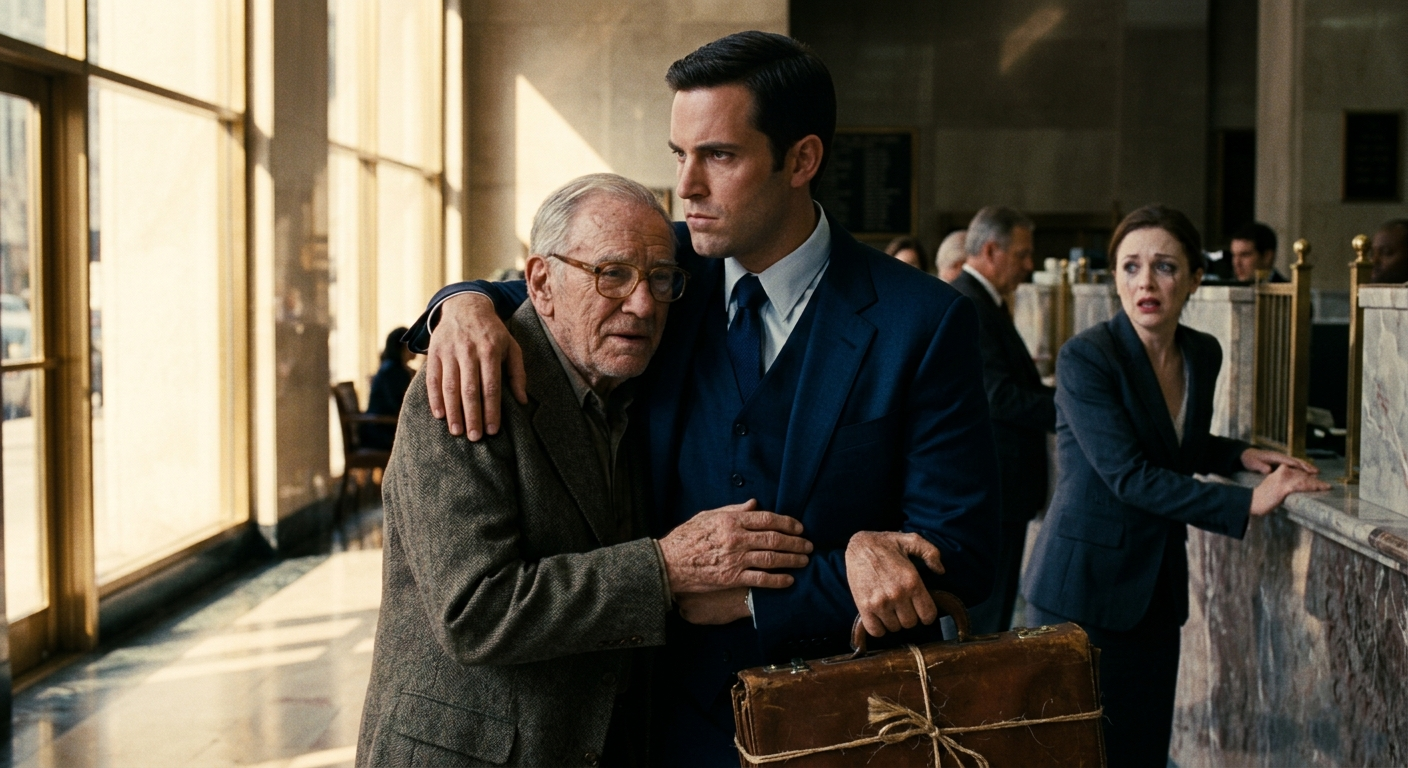
The lobby of Vanguard Trust’s central Manhattan branch smelled of leather, money, and the kind of quiet arrogance that only flourishes behind marble counters.
Michael Peterson had been sitting in the corner for forty minutes.
He was seventy-five years old, wearing a clean tweed jacket that had seen too many winters, trousers neatly patched at the knee, and a pair of thick horn-rimmed glasses that kept sliding down his nose. His fingers — knotted, spotted, the hands of a man who had carried steel and heat and weight for thirty years — held tight to a battered leather briefcase. The latch was broken. He’d tied it shut with nylon twine.
He looked like something the city had accidentally left behind.
“Sir.” Ashley, the senior VIP relations manager, said the word like it was a citation. Her nails were cherry red. Her gaze was the kind that could price a man’s outfit in under a second. “I have now told you three times. Account statements from 1991 require a formal corporate request. Processing time is thirty business days minimum.”
“I understand,” Michael said. “I’m not asking for a statement. I just need to confirm the account is still active. A trust account, opened for my son. I was contributing from my paycheck at the mill every month. With thirty-odd years of interest, there should be—”
“There should be nothing,” Dylan cut in. He was a teller, twenty-something, trimmed beard, the kind of smirk that came free with a business casual dress code. “You know how many bank mergers have happened since 1991? Maintenance fees alone would’ve zeroed that out years ago. And whatever local bank you used? Gone. We absorbed their regional portfolio a decade back. It’s a dead account.”
“The state archive told me—”
“I don’t care what the state archive told you.” Ashley’s voice rose just enough to turn heads. “What I care about is that you have been sitting in this lobby for the better part of an hour, and in fifteen minutes we are hosting a primary institutional investor for a contract signing. So I need you to stand up, pick up your things, and walk out through those doors. Voluntarily. Or I call security and you’re escorted.”
A woman in a cashmere coat near the ATM took several pointed steps backward, as though proximity itself was dangerous.
Michael’s lips moved but no sound came. The humiliation was a physical thing — it pressed down on his chest, behind his ribs. He had worked thirty-two years at the Bethlehem plant. He had commendations framed on the wall of his spare room. He had never once taken something that wasn’t his. And he was being catalogued and dismissed by a woman who saw him as an inconvenience between her and a more valuable human being.
He reached into the briefcase with trembling fingers, carefully retrieving a yellowed paper passbook. He started to fold it back in.
“Chief.” Dylan called out to the security guard at the door — a big man in tactical black — without looking up from his screen. “Can you walk our guest out? He’s having some trouble locating the exit.”
A few tellers at the windows smothered grins behind their hands.
The guard’s heavy boots thudded across the granite. Michael was already standing. He held the briefcase in front of him with both hands.
“I’m going,” he said quietly. He looked Ashley directly in the eyes. “No need for assistance. I’m sorry to have taken up your time.”
The automatic doors at the front of the lobby slid open.
A man walked in.
He moved the way very few people move — with the complete certainty of someone who has never once questioned whether there was space for him in a room. He was thirty-five, maybe. Midnight-blue three-piece suit, the kind of bespoke cut that announces itself without trying. A Patek Philippe on his wrist. Two assistants hurried behind him, portfolios pressed to their chests, barely keeping pace. Beside them, a corporate attorney in a charcoal coat moved with practiced urgency.
Arthur Peterson, CEO of Peterson Development.
Four hundred million dollars. That was the number on the contract being prepared upstairs.
Ashley transformed so completely and so fast it was almost mechanical — posture correcting, smile widening, voice dropping two octaves into something warm and resonant and professionally intimate.
“Mr. Peterson!” She stepped out from behind the counter with her arms slightly open, like welcoming royalty. “What an absolute honor. We weren’t expecting you quite yet — the regional director is on his way down now. Please, let me take you to the private lounge, we have everything ready, the documents, espresso, whatever you—”
She caught the guard’s eye and mouthed it: get him out, now.
The guard grabbed Michael by the elbow.
The old man startled. His grip failed. The briefcase hit the marble floor with a crack like a gunshot, and the broken latch gave way entirely.
Everything spilled out.
Old photographs. Faded union certificates with the Bethlehem Steel letterhead. A small orange prescription bottle. A folded Fourth of July program from 1988. And the passbook — yellowed, dog-eared at the corners, dated 1991 — sliding across the polished floor and coming to rest against the toe of a very expensive leather shoe.
Arthur Peterson had already been walking past.
He stopped.
It wasn’t the sound of the case hitting the floor. It was the cough. A soft, rattling, specific cough — the kind that takes years to develop when a man has breathed in foundry air for most of his working life. Arthur had heard it his entire childhood. He had heard it from the doorway of a small house in Pittsburgh on the last morning he’d come home before the business took over everything.
He turned slowly.
His gaze moved across the gray, overgrown hair. The taped bridge of the glasses. The scar above the right eyebrow — a souvenir from a press accident in 1994 that had required eleven stitches and produced a story Michael had told so many times it had become family mythology.
“Dad?”
The word came out barely above a breath.
The lobby went silent.
Not movie-silent — real silent. The kind where the background hum of the HVAC suddenly becomes the loudest thing in the room. Ashley’s prepared sentence died somewhere between her throat and the open air. Dylan’s pen rolled off the edge of his desk and hit the floor and no one moved to pick it up. The guard took two involuntary steps back.
Michael raised his head slowly. He blinked through the thick lenses. His eyes focused.
“Artie,” the old man said. He said it so softly, so completely without performance, that it was somehow more devastating than anything he could have shouted. “Son. Look at you.”
Arthur’s composure — twelve years of boardrooms, negotiations, closings, a hundred moments of calculated impassivity — lasted approximately two more seconds.
He stepped forward. His shoes walked directly over the scattered papers. He didn’t notice. He went down on one knee on the floor of the bank — in a custom suit that cost more than most people’s monthly rent — and began gathering the photographs with both hands.
“Dad, what are you doing here?” His voice had cracked on the second word and he hadn’t recovered. “Why are you — why are you dressed like this? I’ve been sending money every month. Every single month for four years, through Uncle Tom.”
Michael lowered himself carefully to help collect the papers. His knees ached. They always ached now.
“I know, Artie,” he said. “Tom told me. I got every one.”
“Then why—”
“I didn’t touch it.” Michael folded a photograph carefully — Arthur at age seven, riding his father’s shoulders at a Fourth of July parade, both of them squinting into summer sun. “What do I need all that for? My pension covers the utilities. I’ve got the garden. The old truck. I’m fine.”
“Dad—”
“Your money…” Michael paused. He smoothed the corner of the photograph very gently. “I transferred it. Back into your old childhood trust line. Every month, right back in. I kept thinking — you’re out there, in that big dangerous world of yours, with all those projects and all those risks. What if something falls through? What if one of the big ones goes wrong? I wanted to know there was something solid waiting for you. Just in case.”
Arthur stopped moving. He was holding the 1991 passbook. He stared at it.
“You came here,” he said slowly, “to check on a savings account you’ve been quietly funding… as a safety net. For me.”
“The archive said it was still active. I just wanted to make sure it hadn’t been eaten up by fees or something.” Michael smiled a little, tired and genuine. “The young man at the desk told me it was worthless junk.”
Something happened to Arthur Peterson’s face.
If his assistants had been watching closely — and they were, they were watching every single thing in the room — they would have recognized it. They had seen it once before, in a boardroom in Singapore, when a counterparty tried to slide fraudulent numbers into a fourth-quarter report. A very specific stillness. Very controlled. And very, very dangerous.
He stood up slowly. He helped his father to his feet first, one arm around his waist, making sure he was steady. Then he turned toward the counter.
“Who said that?”
No one answered.
Arthur’s two assistants had quietly positioned themselves a careful three feet further from the desk. The attorney had pulled out his phone and appeared to be taking notes for reasons he would explain later.
“I asked a question.” Arthur took one step toward the counter, his father’s arm still in his. “Who called my father a nuisance? Who was about to have him physically removed from this building?”
Ashley opened her mouth. Nothing came out. Her foundation, under the fluorescents, had taken on the faintly gray quality of wet cement.
The elevator doors opened. Harold Vance, the regional branch manager, came out at something just short of a run. He was a heavyset man, gold-rimmed glasses, the kind of sweat that appears when disaster arrives faster than damage control.
“Mr. Peterson!” He spread his hands as though physically containing a spill. “A catastrophic misunderstanding — completely unacceptable behavior from our staff — I want you to know we take this with absolute—”
“Vance.” Arthur said the name once. Vance stopped talking. “Fire her.” He pointed at Ashley without looking at her. “And him.” Dylan. “Today. No severance. Flag their personnel files — I want it on record why they were terminated.”
“Of course. Absolutely. Right away.” Vance was already gesturing at the back office, his face desperate and sweating. “Ashley, Dylan — clear your desks. I want you out within the hour.”
Ashley sat down. She didn’t decide to sit down. Her legs made the decision independently.
“The Hudson Yards underwriting contract,” Arthur continued. His voice had not changed volume or temperature once. “Four hundred million, correct?”
Vance’s color went somewhere between ash and cream. “Yes, sir. Four hundred—”
“Withdrawn. Peterson Development and all subsidiary accounts will be initiating transfer to alternate institutions within the hour. My legal team will handle the mechanics.” He paused. “I won’t keep capital in a bank where a man is appraised by the fraying on his jacket.”
“Mr. Peterson, please.” Vance pressed his palms together. “We will set up a premier private banking suite for your father — lifetime fee waivers, a dedicated wealth manager, whatever you need, whatever he needs—”
Michael tugged gently at his son’s sleeve.
Arthur looked down.
“Let it go, Artie,” Michael said softly. “They’re young. Foolish. They don’t know any better yet.” He patted his son’s arm twice, the same way he had patted it when Arthur was eight years old and furious about something that seemed world-ending and wasn’t. “Let’s just go. I can’t breathe right in here.”
Arthur looked at his father for a long moment. Something in the fury settled, not disappeared, but settled — the way a fire doesn’t go out but finds its level.
He turned back to Vance.
“The terminations stand,” he said. “You can thank my father that the conversation ends here. The accounts are gone regardless. You’re not fit to manage his money.” A pause. “Not even the ‘worthless junk.’”
He picked up his father’s briefcase from the floor. He closed it as well as the broken latch would allow, securing the twine back into place with careful hands. Then he tucked it under one arm and offered the other to Michael.
“Let’s go, Dad. Mom’s home, right?”
Michael fell into step beside him, leaning slightly on his son’s arm.
“She’s home. Made the pot roast.” He smiled sideways, eyes brightening. “She keeps saying she wishes you’d find a free hour to come by.”
“I’m coming today.” They were moving toward the doors now, past the frozen tellers, past the woman in the cashmere coat, past the guard who was staring at his own shoes with the concentration of a man memorizing a life lesson. “In fact, I’m coming every day for a while. And we’re getting you a new briefcase.”
“The old one’s fine.”
“The old one is held together with string, Dad.”
“String works,” Michael said simply.
Arthur laughed — a real one, sudden and unguarded, the kind that hadn’t come out from wherever he kept it in a very long time.
The automatic doors slid open. Afternoon light hit them both at once.
Behind them, in the echoing silence of the lobby, Ashley stared at nothing in particular. The mascara had traced two dark lines down to her jaw. Across the floor, Dylan quietly placed a framed desk photo into a cardboard box.
Vance stood in the center of the lobby for a long moment, looking at the empty space where four hundred million dollars used to be.
Outside, the two men walked toward a black SUV parked at the curb. Arthur opened the passenger door and helped his father in with a careful, unhurried attention — adjusting the seat, making sure the briefcase was settled safely on the floor. Then he walked around to the driver’s side.
He stopped for a moment before getting in.
He looked up at the skyline — the towers, the glass, the whole vertical argument of the city — and took a long, clean breath.
He hadn’t signed anything today. He had lost a four-hundred-million-dollar contract, two institutional relationships, and an entire morning of scheduled work. He had gained, on the polished floor of a bank lobby, a photograph of a seven-year-old boy on his father’s shoulders.
He got in the car.
He put on his seatbelt.
He drove his father home.
Original fictional stories. AI-assisted creative content



Leave a Reply