Paul Harrison had turned fifty seven days ago. No party, no fuss. Just him, a good bottle of Scotch, and Cooper—his six-year-old Golden Retriever—sprawled across his feet while the evening news droned in the background.
“Best birthday I’ve had in years,” Paul told the dog.
Cooper thumped his tail twice, entirely agreeing.
Their late-afternoon walks through Elmwood Park were sacred. Four-thirty on the dot, every day, rain or shine. Paul would clip the leash, Cooper would do his full-body wag, and together they’d disappear into the Whispering Pines trail while the rest of the city rushed home in traffic.
Paul liked the trail because it was empty. No one trying to make conversation. No one asking how the firm was doing. Just oaks and white pines and the sound of leaves underfoot.
“Getting old, Coop,” Paul said, tugging his flannel jacket tighter. “Fifty years. You’d think I’d slow down by now.”
Cooper glanced back with those amber eyes—patient, attentive—then returned to sniffing the trail edge.
“Yeah. You’re right. Stop complaining.”
They reached the old weathered bench near the oak overlook. Paul pulled a battered tennis ball from his jacket pocket—so worn it was more gray than yellow—and rolled it between his palms.
“Okay, buddy. Go long.”
He lobbed it into the leaf carpet.
Cooper exploded after it, a streak of gold tearing through the red and amber, his paws launching off the packed earth with pure joy.
Paul watched him go, smiling.
Then the smile stopped.
It wasn’t pain at first. It was weight. A crushing, impossible weight behind his sternum, as if someone had pressed a steel plate against his chest and was slowly leaning on it. His next breath didn’t come. He tried again. The weight doubled.
What—
The pain arrived like a circuit breaker tripping. Not sharp—total. It flooded his chest, climbed his jaw, ran a live current down his left arm all the way to his fingertips, which went instantly numb.
His legs gave.
Paul grabbed the bench with his right hand, missed, and went down hard onto one knee. The impact against the dirt barely registered over the fire in his chest. He tried to call out.
“Coop—”
It came out as nothing. A whisper of breath, swallowed by the trees.
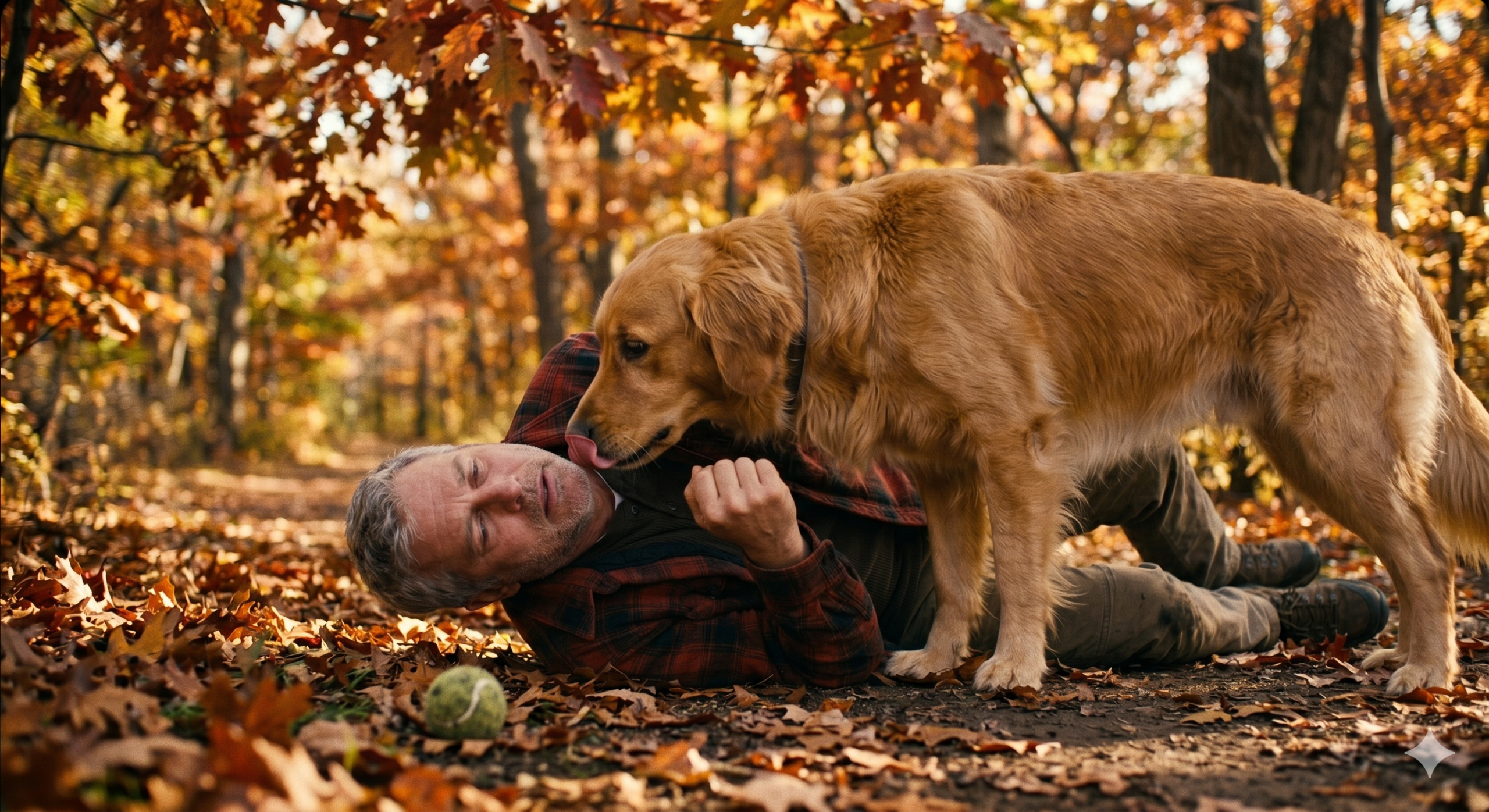
He tilted sideways and hit the ground, one hand clawing at his shirt, cheek pressed into cold leaves.
The colors drained out of the world. The amber canopy went gray. The tree sounds went to silence. The last thing Paul was aware of was the smell of damp earth and the distant sound of rustling leaves.
Then nothing.
Cooper returned thirty seconds later.
He held the tennis ball proudly in his jaws, tail already winding up for the full celebration.
He found the ground where his human should have been standing.
The ball dropped from his mouth.
Cooper stood completely still. His tail went flat. His ears folded back. Every instinct in his six-year-old body—every hour of his entire life spent watching this man, learning his moods, reading his posture—told him something was catastrophically wrong.
He took one cautious step forward. Then another.
He leaned down and looked into Paul’s face.
Paul’s eyes were half-open, unseeing. His lips had gone the color of a cloudy sky.
Cooper let out a sound he had never made before. Low. Broken. Not quite a whimper and not quite a howl—something in between, like a word he didn’t have.
He licked Paul’s face. Licked his forehead. Nudged his cheek hard with his nose.
Nothing.
“Woof.” A sharp bark, right at Paul’s ear.
Nothing.
Cooper reared back, threw his head toward the dimming sky, and let out a howl that split the evening open. Not a playful sound, not a conversational bark. This was an alarm. Raw, full-chested, relentless.
He sprinted to the main trail. Barked at the empty path. Sprinted back. Checked Paul’s face. Howled again. Sprinted out further, barking at the trees, at the air, at anything that might hear.
He refused to leave. He refused to stop.
The park had gone quiet around him. But Cooper kept screaming into that quiet.
Help. Someone. Now.
Dr. Sarah Jenkins had been a cardiologist for eleven years and she had earned every gray hair she was starting to find.
Thirty-six hours into a brutal stretch at Massachusetts General, she had finally handed off her last patient, peeled off her badge, and walked into Elmwood Park with her AirPods in and her eyes pointed at the ground.
She was not thinking about work. She was thinking about a hot bath and whether she had any wine left at home.
The sound stopped her cold.
She pulled out one earbud.
A dog. Barking—no, screaming—somewhere down the Whispering Pines trail. But wrong. The rhythm was wrong. The pitch was wrong. She had grown up with dogs. She knew the difference between a dog barking at a squirrel and a dog in distress.
This was distress.
Sarah broke into a run before she’d consciously decided to.
She found Cooper at the edge of the trail. He spun toward her, let out one sharp, protective bark—and then immediately stepped aside, his body language tilting from guard to please follow me in under a second.
“Easy. Easy, I’ve got you.”
She rounded the oak and saw Paul.
She hit her knees in the dirt before she’d finished processing what she was looking at.
“Sir! Can you hear me?”
Two fingers to his carotid. Pulse—thready, fast, wrong.
“Acute MI. Cardiogenic shock.”
She was already dialing.
“911, I have a male, approximately fifty, in cardiac arrest at Elmwood Park, Whispering Pines trail near the oak overlook. Thready pulse, agonal breathing. I’m a physician—I’m starting CPR now. I need an ALS unit with a crash cart, right now.”
She set the phone on the leaves, ripped open Paul’s flannel shirt, rolled him flat, and locked her hands over the center of his chest.
Cooper sat two feet away and did not move.
He watched her hands.
“Come on,” Sarah muttered, throwing her weight into the compressions. “Stay with me. Fight.”
Cooper let out a soft, low sound—barely a whimper. Almost like encouragement.
One, two, three, four—
She didn’t look at her watch. She didn’t look at the sky. She kept her eyes on Paul’s chest and her hands moving and her count steady, because if she stopped, that was it, and she was not letting it be it.
When the sirens cut through the trees, she felt something loosen in her chest that she hadn’t realized she’d been holding tight.
“Over here! Whispering Pines, follow my voice!”
Red and blue strobed through the pines. Two paramedics came at a dead sprint, LifePak banging against one of their hips.
“Doc, we got it—swap out!”
“He’s been down at least five minutes, maybe more. No bystanders. Dog alerted me.”
The paramedic glanced at Cooper, who hadn’t moved.
“That dog’s a hero.”
“Do your job,” Sarah said.
They did. Leads went on. The monitor screamed its chaotic alarm.
“V-Fib. Charging—clear!”
Paul’s body arched off the ground.
Cooper flinched. Held his ground.
“Still in V-Fib. Increasing energy—clear!”
The monitor went flat.
Then—beep.
Beep.
Beep.
“Sinus rhythm.” The paramedic exhaled. “We’ve got sinus rhythm.” He looked up at Sarah. “If you hadn’t been here—”
“The dog got me here,” Sarah said simply. “Let’s move him.”
They wouldn’t let Cooper past the hospital doors.
Three separate staff members tried to walk him to the parking lot. He sat down, went soft as a sandbag, and did not move. They called animal control. Animal control took one look at the situation and said they’d come back.
By midnight, Cooper was a semi-official fixture on the front welcome mat, operating on a borrowed water bowl and half a turkey sandwich from the overnight security guard named Marcus.
“You’re not supposed to be here,” Marcus told him.
Cooper looked at the double doors.
“Yeah,” Marcus said. “I get it.”
The ICU was white and beeping and smelled of antiseptic. Paul came back to it slowly, over the course of three days, the way a photograph develops—dim shapes first, then outlines, then finally the whole image snapping into focus.
On the fourth morning, he opened his eyes to a sunlit recovery room and a woman in a white coat reading something on her phone in the chair beside him.
She looked up.
“Well,” she said. “Welcome back.”
Paul’s mouth was dry. His chest ached with a deep, internal soreness, like his ribs had been rearranged from the inside—which, in a way, they had.
“Where…” His voice came out like gravel. “Where’s Cooper?”
Sarah smiled. “Your dog is currently holding the front entrance of this hospital hostage. He has been there for four days. The night shift has named him Chief.”
Paul stared at the ceiling.
“I’m Dr. Jenkins,” she said. “I found you in the park. You had a major MI—LAD occlusion. We placed a stent. You’re going to make a full recovery, but you are going to have to make some changes.”
“The dog got you there.”
“The dog got me there,” she confirmed.
Paul closed his eyes. A tear ran sideways into his silver stubble.
“I had no idea,” he said quietly. “I always thought—if it happened out there—alone—that was it. I thought I’d just… not come back.”
“You didn’t do it alone,” Sarah said. “You just didn’t know your backup was four-legged.”
The next four weeks were hard in the way that slow recovery is always hard—not dramatic, not cinematic, just daily and grinding and incremental. Paul walked to his door. Then to the nurse’s station. Then around the floor. He learned the new vocabulary of his condition: beta-blockers, ejection fraction, cardiac rehab, target heart rate. He learned to eat differently, sleep differently, think about his body differently.
Every morning, Sarah stopped by with a Cooper update.
“Ate his whole bowl. Marcus has been spoiling him with treats.”
“Did two laps around the courtyard with the PT assistant. Apparently very good on a leash.”
“He slept against the front doors last night. Literally would not let anyone in or out for twenty minutes.”
Paul smiled at every report. Cooper was waiting. That was the deal.
He was not going to break the deal.
Discharge day fell on a cold Tuesday in late November.
Paul stood in the hospital lobby in his flannel jacket—cleaned and pressed by the nursing staff as a going-home gift—holding his discharge papers and a small white bag of prescriptions. His heart beat with a steadiness that still surprised him. Not just fixed. Better than it had been in years, now that the blockage was gone.
Sarah stood across from him, hands in her coat pockets.
“Mediterranean diet,” she said. “The meds at the same time every day—don’t skip, don’t improvise. Light walking to start, building up. No heavy lifting for a month. Cardiac rehab appointment is Thursday.”
“I know,” Paul said. “I’ve been paying attention.”
“I know you have. I just like saying it.” She extended her hand. “Take care of yourself, Paul. You’re a good patient.”
He shook it. “You saved my life.”
“Cooper saved your life. I just did CPR.” She paused. “Don’t make me do it again.”
“Deal.”
He turned toward the automatic glass doors.
They slid open. Cold air came through, clean and sharp, carrying the last edge of November.
Paul stepped outside.
He stood at the top of the concrete steps and looked down.
At the bottom, on the dead grass beside the sidewalk, sat Cooper. He was being held on a borrowed leash by Paul’s neighbor, Mrs. Chen, who had been bringing him to the hospital grounds every single day. Cooper was sitting very properly—spine straight, ears up, exactly as still as a dog of his enthusiasm could manage.
For one second, neither of them moved.
Then the glass doors chimed behind Paul.
Cooper’s head snapped up.
Their eyes met.
Cooper came apart completely.
The sound he made was not a bark and not a howl—it was a single, high, ecstatic note, the sound of a held breath finally releasing, and he launched himself up the steps in a blur of gold before Mrs. Chen even had time to let go of the leash.
Paul dropped to one knee on the concrete, ignoring every restriction he’d been given, and opened his arms.
Cooper hit him like a freight train.
He was everywhere at once—licking Paul’s face, pushing his nose into Paul’s neck, spinning in a circle and coming back for more, his entire body vibrating at a frequency that barely qualified as physical. He was barking and whining simultaneously, the way dogs do when language is simply not enough.
“Okay, okay—” Paul laughed through tears, both arms locked around the dog’s thick neck. “I’ve got you. I’m here. I’m okay.”
Cooper went suddenly still.
He pulled back a few inches and looked at Paul directly. Studied his face with those amber eyes—patient, serious, conducting some internal inspection that Paul couldn’t quite name.
Then, with the deliberate care of a surgeon, Cooper raised his right paw and pressed it flat against Paul’s chest. Left side. Exactly over the stent. Over the repaired heart.
He held it there.
Paul looked down at the paw on his chest. He covered it with his own hand.
“It’s good,” Paul told him quietly. “The doctor fixed it. It’s beating right. You can check—feel it.”
Cooper held the paw there a moment longer.
Then he dropped it, gave one sharp, satisfied bark, and stepped to Paul’s left side, shoulder to shoulder, leash slack between them. He looked down the sidewalk toward the street. Ready.
Mrs. Chen was crying openly three steps above them. Marcus the security guard, standing in the lobby doorway he’d propped open, was very deliberately looking at something on his phone that required enormous concentration.
Paul stood up. Took a long, clean breath of the cold air. Picked up Cooper’s leash.
“Alright, buddy,” he said.
Cooper’s tail was already going.
“Let’s go home.”
They walked down the steps together—stride matching stride, shoulder at knee—and turned toward the street, toward the bare November trees and the long quiet miles still ahead of them.
Original fictional stories. AI-assisted creative content



Leave a Reply