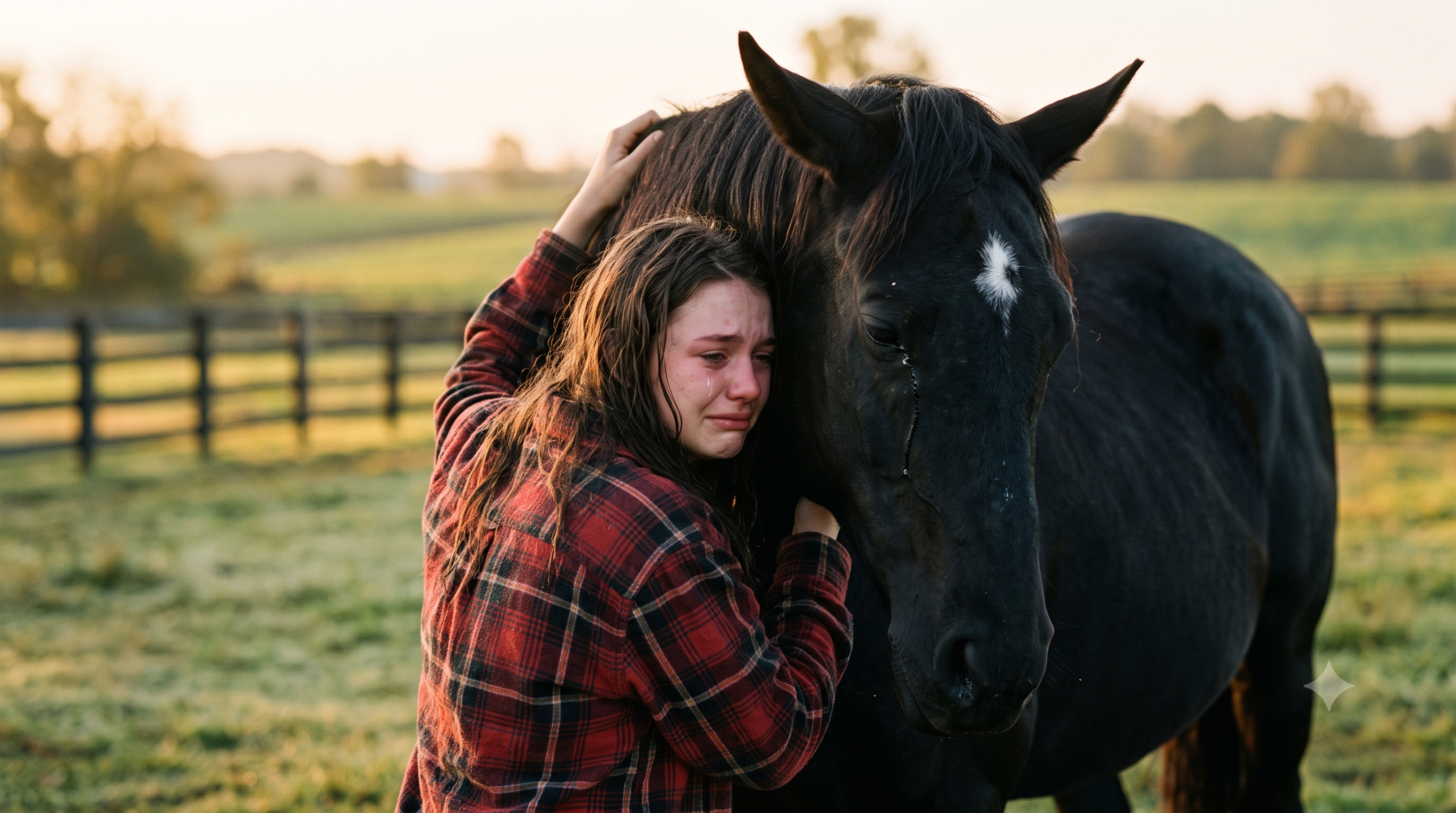
The morning Savannah said goodbye to Maverick, she made him a promise no eighteen-year-old should ever have to make.
“I will find you. No matter how long it takes.”
The commercial transport truck pulled away from Whispering Pines, and from inside the trailer came a sound she would never unhear — a long, screaming neigh that split the cold Kentucky air like a blade. Savannah collapsed in the gravel driveway, pressed her hands over her ears, and sobbed until she couldn’t breathe.
That sound became her fuel for the next seven years.
The foreclosure had come fast and ugly. Her father, an honest man who trusted the wrong partner, had sunk every dollar they owned — savings, land, loans — into a state-of-the-art equine rehab facility. His business partner embezzled the funds and disappeared overnight. The banks moved in before the family could blink.
Everything went to auction. The farm. The homestead. The horses.
Maverick — a jet-black Hanoverian gelding with a white star shaped like a falling spark — was purchased by Richard Vance, a livestock dealer who saw horses as line items, not living things.
Within forty-eight hours, Vance had flipped him through a middleman. The trail went cold almost immediately.
Savannah was eighteen years old, living in a cramped Atlanta apartment, and she had just lost the one living creature who had ever understood her without words.
She didn’t grieve the way people expected her to. She got to work.
Pre-veterinary school during the day. Mucking stalls at a racetrack at night. Grocery delivery on the weekends. Every dollar she didn’t spend on survival went into a thick leather notebook and a growing list of leads.
Black Hanoverian gelding. White star, spark-shaped. Distinctive.
She scoured USEF databases, equine forums, livestock auction listings from Georgia to Montana. She called trainers, judges, and transport drivers.
Most of them said the same thing.
“Kid, there are thousands of black sport horses out there. He’s probably been renamed. Sold west. Or sent to a low-end auction if he went lame.”
“He didn’t go lame,” she said every time, and hung up.
Year One. She drove to every major boarding and training stable across Georgia and the Carolinas. She walked barn aisles, held her breath every time she spotted a black hindquarter in the shadows, ran forward, and every single time found the wrong face looking back at her.
“You can’t keep doing this,” her mother said one night. “Savannah, you have to build a life.”
“I am building a life,” she said. “I’m building the kind of life that can bring him home.”
Her mother didn’t argue again after that.
Year Three. She expanded the search to rural auctions and private farms across five states. She paid livestock scouts retainers out of money she couldn’t really spare. She drove six hours on a Sunday to look at a horse a farmer described as “a real big black fella with a mark on his head” — only to find a chunky quarter horse with a blaze, not a star.
She cried in the truck on the way home. Then she crossed the lead off in the notebook and opened a new page.
At night, the same nightmare came on a loop: Maverick running through a vast, barren field, hooves bleeding, calling out to her while she stood frozen in fog, unable to move, unable to reach him. She would wake at three in the morning, soaked in cold sweat, and immediately reach for the notebook.
There was always one more lead to check.
Year Five. She graduated at the top of her veterinary class, specializing in equine medicine. Her professors said she had an uncanny gift with traumatized horses.
“You feel their pain,” her mentor told her after she successfully gentled a panicked stallion that three other vets had already walked away from.
“I’m just looking for the one I let down,” she said quietly.
With a real income, she could finally afford professional livestock locators and access to proprietary shipping manifests. She hired two scouts on retainer and set up automated alerts across forty-seven auction sites.
The people around her told her to move on. To date. To let go.
Maverick’s old leather halter still hung on her bedroom wall. Some nights she pressed her face into it, convinced she could still catch the faint ghost of sweet feed and Kentucky grass.
She was not going to let go.
Year Seven. A freezing November evening, pulling an overnight shift at the equine hospital.
Her phone buzzed.
It was an alert from an old livestock scout in Tennessee — a man she’d been paying a modest monthly retainer for three years without a single useful result.
The text was short. One grainy photo attached.
“Take a look at this. Looks like an old sport horse dumped at a backyard breeder’s place. Bought for pennies at an unverified loose-horse auction a year ago. No papers, they just call him ‘Midnight.’ He’s in bad shape. But look at the forehead.”
Savannah zoomed in.
Standing hock-deep in freezing mud was a severely emaciated animal. Ribs jutting through a dull, matted coat. Rain-scalded back. Head hanging completely to the ground. A creature who had stopped expecting anything from the world.
But on his forehead — beneath a crust of dried mud — there it was.
The spark.
“Oh my god,” Savannah whispered in the empty office. Her hands were shaking so hard she almost dropped the phone. “It’s him.”
She was in her truck with a borrowed trailer within thirty minutes, hauling permits paid on an empty credit card, driving straight into a severe weather front without a second thought.
Seven years of searching. She was not stopping now.
The property in rural Tennessee looked like the end of the world.
Rusted machinery. Collapsing outbuildings. A dilapidated mobile home surrounded by dead grass and mud. A man in a stained jacket stepped out and looked her truck over with suspicion.
“What do you want?”
“The black gelding,” Savannah said, stepping out of the cab. “The one in the back paddock.”
“That old skin-and-bones?” He spat into the mud. “Take him if you got the cash. He can’t work, he’s eating feed I can’t afford, and I was hauling him to the auction block next Tuesday anyway. Eight hundred bucks.”
Savannah pulled the bills from her jacket pocket and put them in his hand without a word.
She was already walking toward the shed.
She pushed open the rotting gate and stopped.
The air inside was thick with damp and neglect. The smell of mold and old straw and the particular sourness of a horse who hadn’t been properly cared for in years. Standing in the darkest corner, pressed against the boards with his head down, was the horse.
Savannah stood still for a long moment, just looking at him.
His once-glossy coat was sun-bleached and caked in filth. His ribs were a visible map of everything he’d suffered. His hindquarters bore the old marks of rough handling. His overgrown hooves were cracked and splitting. He kept his face pressed into the corner, tense all over, expecting nothing from a human being except the next blow.
A sound escaped her throat — ragged, involuntary.
“Maverick,” she said. Her voice cracked on every syllable. “Maverick, big boy… it’s me.”
The horse didn’t move.
She took one slow step forward, then another. She extended her hand — the same hand that used to feed him crisp red apples in the lush Kentucky pastures — and she began to hum. A low, quiet melody. The one she used to sing to him when he was a frightened young colt and the world felt too big.
For a long moment, nothing happened.
Then — one ear twitched.
It rotated backward, locking onto the sound. His whole body went very still, the tension shifting from braced-for-pain to something he clearly didn’t recognize anymore. Something he’d stopped believing in.
He turned his head. Slowly. With the deep, labored caution of an animal who had been disappointed so many times that hope itself had become dangerous.
When his eyes — clouded with age and exhaustion — met hers, something moved in them. A flicker. A recognition too old to be extinguished by seven years of suffering.
He flared his nostrils. Drew in a long, trembling breath.
And then Maverick made a sound that was nothing like a nicker, nothing like a neigh. It was a low, hollow, heartbreaking groan — the sound of a creature who had been holding something in his chest for years and was finally, finally allowed to put it down.
He took one unsteady step forward. His legs shook under the weight of his own body. He crossed the stall and pressed his massive, worn muzzle directly into her chest.
Savannah sank to her knees in the mud. She wrapped her arms around his neck and buried her face in his tangled, dirty mane and wept so hard her whole body shook.
“I found you,” she kept saying, over and over. “I’m here. I’ve got you, my beautiful boy. I’ve got you.”
And from the eye of the weary, broken horse, a single large tear spilled over and cut a clean, clear path through the dirt on his face.
They wept together, just as they had seven years ago in the ruins of their old life. But this time, the tears meant something entirely different.
Loading him took over an hour. His legs buckled twice. But he followed her, eyes never leaving her face, trusting her the way he always had — completely and without reservation — because she had come back for him when the whole world said she was wrong to look.
Savannah drove him to a rehabilitation stable she had pre-arranged: a quiet, state-of-the-art facility with a large, deeply bedded box stall filled with premium hay, specialized feeds, and every supply she needed. As his veterinarian, she mapped out his entire recovery program before they even arrived. She would manage his arthritis, treat his neglected hooves, rebuild his muscle mass with careful nutrition and graduated movement.
The physical healing was the easy part.
By the time they pulled in and got him settled, the storm had passed entirely. A quiet evening light settled over the property. Maverick stood in his clean, warm stall, surrounded by pine shavings and the smell of fresh hay, a basket of crisp red apples by his feeder.
He didn’t eat right away.
Instead, he turned his head toward the stall door where Savannah stood watching, and looked at her with the calm, steady recognition of a horse who had found, against all odds, his person.
She walked in. Took his face gently in both hands. Pressed a long, quiet kiss directly against the white star on his forehead — the spark that had guided her through seven years of searching and brought them both out the other side.
“It’s over,” she said. “You’re safe now. No one is ever taking you from me again.”
Maverick let out a long, slow exhale — a sound like a house settling after a storm — and rested his great head on her shoulder.
For the first time in seven years, he closed his eyes.
Outside, the evening was still and clear. The past was behind them. The farm that had stolen everything from this family — the foreclosure, the crooked business partner, the years of grinding poverty — had ultimately failed at the one thing it meant most to accomplish. It could not break this bond.
Richard Vance, the dealer who bought Maverick for profit and discarded him for loss, had eventually lost his livestock license to a fraud investigation. The properties he’d stripped and flipped over the years were the subject of a state audit. He spent two years in court. He lost.
Savannah’s father had rebuilt — slowly, honestly — and was working as the head farrier for a respected training barn in Georgia. Her mother’s bookkeeping business had grown into a small firm.
And Savannah — the girl who’d been told for seven years to let go, to move on, to be realistic — had a veterinary practice, a rehabilitation program for neglected sport horses, and a black Hanoverian gelding with a spark-shaped star sleeping peacefully in the stall next to her office window.
She had kept every single promise.
And so, finally, had the universe.
Original fictional stories. AI-assisted creative content



Leave a Reply