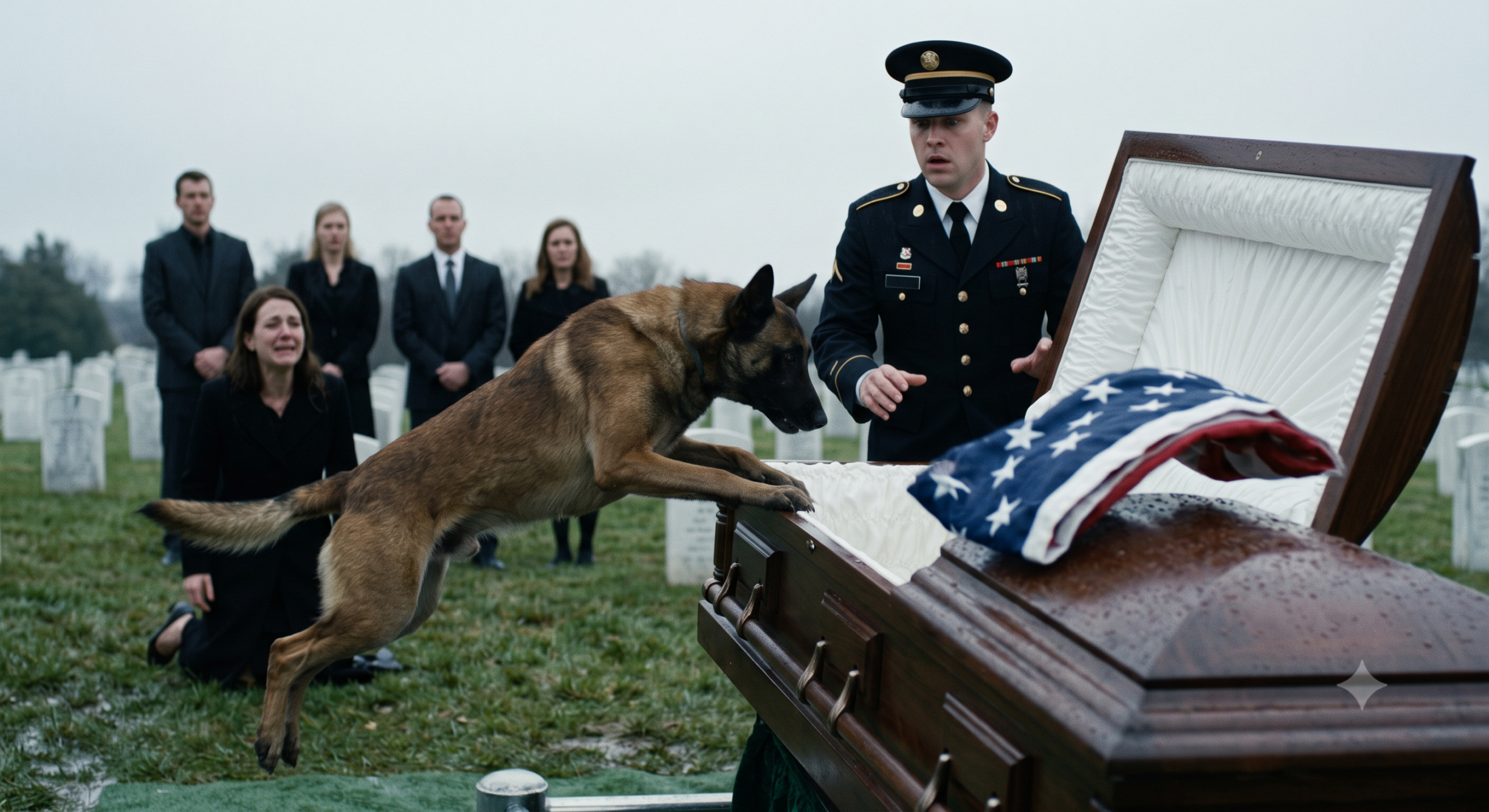
Arlington, Section 60
The rain hadn’t started yet. It was just waiting.
Sergeant Mike Kowalski stood at the edge of the grave site, a leash wrapped twice around his fist. At the other end of it sat Bastian — seventy pounds of trembling Belgian Malinois, ears pinned, eyes locked on the oak casket draped in the American flag.
“Easy, Bas,” Kowalski whispered. “Easy, brother.”
Bastian didn’t look at him. His nose was working, pulling in air in short, hard pulls.
Mrs. Davis stood at the front row, a folded handkerchief pressed to her mouth. Sarah, Andrew’s fiancée, held her other arm, both women dressed in black, both barely standing.
Colonel Miller stepped to the small podium. Gray-haired, square-jawed, voice trained for eulogies.
“Captain Andrew Davis gave his life so others could live,” Miller said. “Today we honor that sacrifice.”
Kowalski tightened his grip on the leash. Bastian had started to growl, low, almost under his breath.
“Not now,” Kowalski murmured. “Please. Not now.”
Four Years
Kowalski hadn’t always handled Bastian. That had been Andy’s job, every single day for four years, since the dog was a gangly nine-month-old washing out of basic obedience for being “too independent.”
“Too independent just means smarter than the handler,” Andy had told the evaluation board, half-joking, half not. “Give him to me. I’ll prove it.”
He had. Kandahar, two deployments, eleven confirmed finds — IEDs, weapons caches, a hidden tunnel that would have killed an entire patrol if Bastian hadn’t stopped dead in the dust and refused to take one more step forward no matter how hard anyone pulled.
“He doesn’t lie,” Andy used to say, scratching behind that torn ear. “Dog’s never once given me a false positive. World could use more of that.”
Kowalski remembered that conversation now, standing at the edge of the grave, watching the same dog strain against a leash like he meant to tear the cemetery apart with his teeth.
“I know, Bas,” he muttered. “I know he never lied to you. I’m sorry the rest of us aren’t built that way.”
The Smell That Wasn’t There
The chaplain raised a hand. The honor guard — seven men in white gloves — stepped forward, rifles tucked, ready for the final folding of the flag.
Bastian’s whole body had gone rigid.
He knew this casket. He’d smelled wood like this before, varnish, brass hinges, the mothball stink of a folded flag. What he hadn’t smelled — not once, not for a second since they’d set this box on its stand — was Andy.
No coffee. No gun oil. No leather. No skin.
And no death, either. Bastian knew death. He’d smelled it in Kandahar more times than any animal should have to. Death had a weight to it, sweet and heavy and final.
This box smelled like canvas and dust. Like sandbags.
Bastian let out a whine that cracked into a bark.
“Sergeant,” Colonel Miller said without turning his head, “control your dog.”
“I’m trying, sir.”
“Try harder.”
A woman in the second row hissed, “Someone get that animal out of here, this is a funeral—”
That was the word that broke something in Bastian. Funeral. He didn’t know the word. He knew the smell of a lie, though, and right now this entire field full of grieving humans was standing around one.
What the Smoke Remembered
For one half-second, Bastian wasn’t standing on wet Virginia grass anymore.
He was back in the dust. The compound wall folding sideways in a roar that blew out the world’s volume. The shockwave throwing him sideways into broken brick, pain shooting up through his ribs, smoke so thick it had a texture, almost a weight.
He remembered scrambling on three legs, searching, searching, calling out the only way he knew how — and finding nothing but blood-smell and cordite where Andy’s scent should have been.
He remembered strangers’ hands grabbing him, a needle, darkness.
He remembered waking up in a kennel that smelled like antiseptic and nothing else, and a string of soldiers coming by one at a time to crouch in front of his cage, voices low, eyes wet, saying words he didn’t know but understood anyway. Gone. Hero. Sorry, boy.
He had believed them. For weeks, he had believed them, because dogs do not question their humans, even when their humans are wrong.
But now, in this field, with this box, his nose was telling him something his humans refused to hear: they are wrong again.
That was the thought — if a dog’s mind can be said to hold a thought — that broke the leash before Kowalski’s hand ever let go of it.
The Lunge
The leash tore out of Kowalski’s hand so fast it stripped skin off his palm.
“Bastian!”
Too late. The dog was already airborne, a black-and-fawn blur crossing fifteen feet of wet grass in under two seconds. He hit the pedestal chest-first. The flag slid, crumpled. His front paws slammed onto the lid.
A bark tore out of him, deep and tactical, the kind he’d been trained to use to mark an IED, not a coffin.
“Get him off!” Miller barked. “Get him off now!”
Two soldiers lunged for the dog. Bastian spun, bared his teeth, and the sound that came out of him made both men freeze mid-step.
“He’s never done this,” Kowalski said, stumbling toward the pedestal, hands raised. “Bas, down. Down.“
Bastian wasn’t listening to anyone. His claws found the seam between the lid and the casket and dug in.
“This is a desecration,” Miller snapped. “Sergeant, if you cannot control this animal—”
“With respect, sir, give me one second—”
There wasn’t one second. Bastian threw his whole body weight sideways. The unfastened lid — never nailed, just resting under the flag per protocol — lost its balance against the men grabbing at the dog.
It hit the stone slabs with a crack that silenced the entire cemetery.
Sandbags
Nobody moved.
The flag had slid half off the overturned lid and lay crumpled in the wet grass. The casket stood open.
Mrs. Davis took one step forward. Then another.
Inside: white satin. A pressed dress uniform, sleeves folded just so to suggest the shape of arms. A service cap resting where a head should be.
And underneath the uniform — stacked, gray, ordinary — sandbags.
“There’s nobody in there,” Sarah said. Her voice didn’t sound like her own.
Kowalski, on his knees beside Bastian now, said it again, quieter, like he needed to hear himself say it to believe it. “It’s empty. He’s not in there.”
“Empty,” someone repeated behind him. Then louder. “It’s empty! Where’s the body? Where is Captain Davis?”
Colonel Miller’s face had gone the color of the headstones. “That’s not possible. We had documentation. Dog tags, a closed liner, identification confirmed at the morgue—”
“Then where is he?” Mrs. Davis’s voice cracked down the middle. “Where is my son?”
Miller had no answer. Bastian, freed from Kowalski’s grip, hopped his front paws onto the casket’s edge and pushed his nose into the folded uniform, the cap, the sandbags, like he was checking, one more time, to be absolutely sure he was right.
He looked up at the crowd with something that, on a human face, would have been called I told you so.
A Sound From the Gate
Mrs. Davis sank into the mud on her knees. Nobody moved to help her. Everybody was still staring into the open box.
Then Bastian’s head snapped up.
His one good ear and his one torn ear both swiveled toward the cemetery gates. The hair down his spine stood straight up.
He made a sound none of them had heard from him before — high, thin, almost human, climbing into something that wasn’t quite a bark and wasn’t quite a cry.
“Bastian?” Kowalski reached for him. “What is it, boy, what—”
The dog was already gone, four legs throwing mud, running like the war was starting all over again — except this time he was running toward something, not away.
The crowd, still frozen around the ruined casket, turned to follow his path.
A man was coming through the Memorial Gates. Leaning hard on a wooden crutch that didn’t match anything he was wearing. A stranger’s jacket, two sizes too big. A beard nobody recognized. Bandages wound dirty and uneven around the left side of his skull.
He walked like every step cost him something.
But his eyes, even at this distance, were a color Mrs. Davis had carried in her chest for thirty years.
Reunion
Bastian hit him like a freight train.
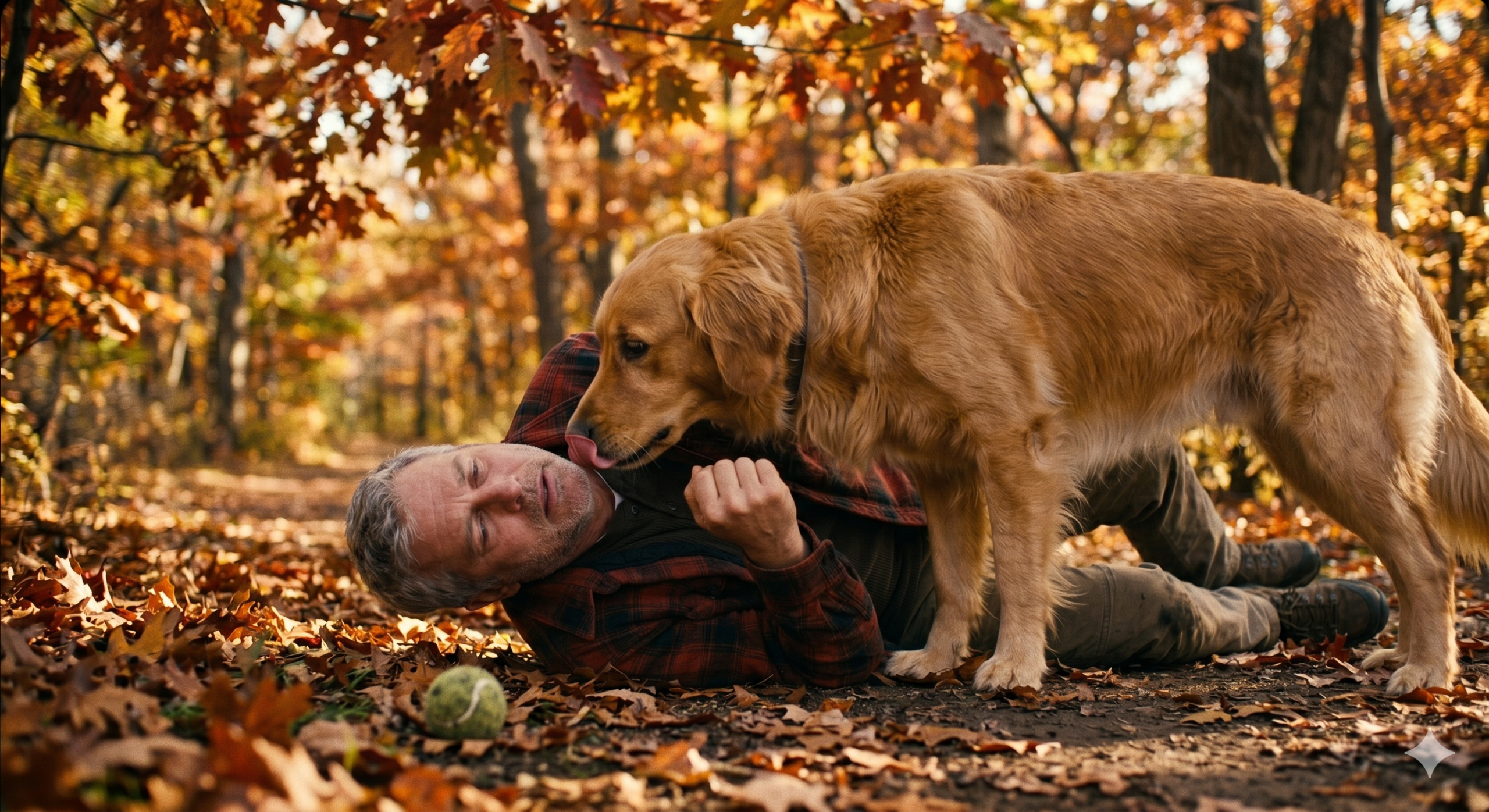
The crutch flew sideways. Both of them went down into the wet grass, the dog on top, licking, whining, howling, shoving his nose into the man’s neck like he was trying to climb inside him.
“Bas—” the man laughed, and it broke halfway into a sob. “Bas, easy — easy, boy — I’m here—”
“Andrew?” Mrs. Davis’s voice came out as barely a whisper, then exploded into a scream that tore across the entire cemetery. “ANDREW!“
She ran. She lost a shoe in the mud and didn’t stop for it. Sarah ran behind her, both of them half-falling onto the man and the dog tangled together on the ground.
“Mom—” Andrew got an arm free, pulled her into his chest. “Mom, I’m here, I’m okay—”
“They told us you were dead. They told us—” She couldn’t finish. She just held on.
Colonel Miller stood frozen at the pedestal, staring at the empty casket, then at the living man wrapped in his mother’s arms thirty yards away, then back at the casket again, like his brain couldn’t process both images at the same time.
“Sergeant Kowalski,” Miller said, very quietly. “Get me Captain Davis’s full chain of custody file. Today. Now.”
“Yes, sir.”
What Happened
It took Andrew three minutes to stop shaking long enough to get the words out, sitting on the wet grass with his mother on one side, Sarah on the other, and Bastian pressed against his back like a living wall.
“The blast threw me into the rubble,” he said. “Tags ripped off in the explosion. I don’t remember the next two weeks at all. A family in a village outside the wire pulled me out, hid me, fed me. By the time my head cleared enough to know my own name, everyone already thought I was someone else’s casualty.”
“You walked,” Sarah said. “All this way, with a concussion and a hole in your leg, you walked.“
“Wasn’t going to wait for paperwork to catch up,” Andrew said. “I crossed two checkpoints with nothing but a stranger’s coat and Bas’s name written on my arm so I wouldn’t forget it.”
Kowalski crouched beside them, his radio already in his hand. “Sir — Captain Davis is alive. Confirmed, in person, at the gravesite. I need medical and CID out here immediately.”
Miller’s jaw worked. “CID?”
“Sir, with respect — somebody signed off on an empty casket as a confirmed identification. Somebody told this family their son was dead with a name tag and no body to match it. I want to know who, and I want it in writing before the sun goes down.”
Miller looked at the overturned lid, the flag crumpled in the mud, the dog who had refused to let a lie stand at attention.
“Make the call,” Miller said.
The Investigation
It didn’t take long to find the mistake — and it was, in the end, exactly that: a mistake, not a conspiracy, which somehow made it worse to sit with. In the chaos after the blast, two sets of dog tags had been recovered near the same collapsed wall. A different soldier’s remains had gone home under Andrew’s name. Andrew’s empty “transfer case,” weighted to pass a cursory check, had gone home under no name at all — just a closed casket and a confirmed officer’s signature nobody had double-checked against the actual contents.
CID arrived within the hour, and the questions started before the rain even let up.
“Who signed the identification confirmation?” the investigator asked, standing over a folding table with Andrew’s file spread open.
“Lieutenant Colonel Reyes, forward logistics,” Miller said. “He confirmed remains transfer based on tag recovery and unit reporting.”
“Did he physically verify the contents of the casket before it shipped?”
Miller’s silence answered for him.
“So no one looked inside the box,” the investigator said. “Not once. Not at the point of origin, not at Dover, not here.”
“The protocol assumes—”
“The protocol assumes wrong, Colonel. I’ve got an empty casket and a live officer standing forty yards from his own funeral. Protocol just failed in front of two hundred witnesses and a dog.”
Within a week, the other family — who had buried a body they believed was their own son under the wrong headstone three states away — got the truth too, delivered in person, with an apology that should have come a long time before any flag was ever folded.
Colonel Miller stood in front of both families inside of one month. He didn’t read from a card.
“I told a mother her son died a hero,” he said to Mrs. Davis, “without confirming there was a hero in the box. That’s on me, and it’s on a system that let it happen. It will not happen to another family on my watch.”
Mrs. Davis looked at him for a long moment. “Apology accepted, Colonel. But I want to know it changes.”
“It already has,” Miller said. “No casket leaves a forward base without two independent physical verifications. No exceptions. I made sure of that personally before I came here.”
The officer who’d signed the false confirmation without verifying the remains was relieved of duty and referred for formal review. He never spoke to either family directly. He didn’t have to. The empty casket had already said everything that needed saying.
Mrs. Davis didn’t ask for any of that disciplinary action. She got it anyway, because Andrew was alive to ask for it himself, and because nobody in that chain of command wanted to be the next name a dog had to expose.
What Stayed
Six months later, Bastian retired from active service with a medical waiver nobody argued about. Captain Andrew Davis, on a cane now instead of a crutch, stood beside Sergeant Kowalski at a small ceremony — no flags this time, no folded uniform, just Bastian getting a small bronze tag added to his collar: Refused to Bury a Lie.
Sarah cried through the entire five minutes of it. So did half The Old Guard, who’d come not on duty this time, just to watch.
“You know,” Kowalski said afterward, scratching behind Bastian’s torn ear, “Army’s never going to put that on an official record. Dog disobeys direct orders, exposes command failure, saves a family from burying the wrong story.“
“Don’t need the record,” Andrew said, dropping a hand onto Bastian’s head. The dog leaned his whole weight into it, the way he always had. “He knows what he did.”
Bastian looked up at him — coffee, gun oil, soap, life, all the scents finally back where they belonged — and let out one short, satisfied bark, like a door closing on something that was finally, completely finished.
Nobody buried anybody that didn’t belong in the ground. Nobody folded a flag over an empty lie. The truth had cost a command officer his career and an Army its easy comfort — and it had given a mother her son back.
Some debts get paid in disciplinary paperwork. This one got paid the moment a dog refused to stand at attention for a casket that smelled like nothing at all.
Original fictional stories. AI-assisted creative content



Leave a Reply